Inside the Space Station Lab Where Matter Almost Stops Moving
NASA's Cold Atom Lab aboard the ISS is cooling atoms to near absolute zero, producing a rare fifth state of matter impossible to study on Earth.
A Refrigerator-Sized Machine at the Edge of Physics
There is a box aboard the International Space Station roughly the size of a mini refrigerator, and it is doing something that cannot be done anywhere else. It cools atoms - rubidium and potassium - to temperatures below minus 459 degrees Fahrenheit (minus 237 degrees Celsius), a fraction of a degree above the coldest temperature physically possible. At those temperatures, atoms stop behaving like the tiny colliding billiard balls of high-school physics. They spread out into waves, overlap, pass through each other, and merge into a single quantum object that follows rules the everyday world never prepares you for.
The facility is NASA’s Cold Atom Lab, built at the Jet Propulsion Laboratory in Southern California and controlled remotely from Earth. A freshly upgraded science module arrived at the station on April 11 aboard a Commercial Resupply Services mission, and the lab is now back in operation. Five international research teams are currently running experiments through it, studying fundamental physics in conditions that no ground-based laboratory can replicate.
What the Fifth State of Matter Actually Is
Most people learn four states of matter in school: solid, liquid, gas, plasma. The Cold Atom Lab is producing a fifth - a Bose-Einstein condensate, or BEC. When atoms are cooled just above absolute zero, they can combine into this unusual quantum state, where the wavelike nature of matter takes over entirely and the whole collection of atoms behaves as a single coherent quantum object.
A BEC is made of matter waves. It is much larger than any individual subatomic particle, yet it still obeys quantum mechanics rather than the classical physics that governs the objects you can hold in your hand. “At the coldest temperatures, matter behaves drastically different from anything we have experienced,” said Jason Williams, project scientist for Cold Atom Lab at JPL. “The wavelike nature of matter dominates, and ultracold matter can behave in ways that are not only unexpected, but that also enable extremely precise measurements of time, gravity, and motion.”
That last point matters beyond pure curiosity. The lab also functions as a development platform for quantum instruments that could eventually support Earth science investigations and deep-space exploration missions - technologies that would need to work reliably far from any repair crew.
Why the Space Station Changes Everything
You can study ultracold quantum gases in a ground-based laboratory. Researchers have done it for decades. But Earth’s gravity works against you in a specific and frustrating way: it pulls on the atomic cloud, shortening the window during which scientists can observe it and limiting how cold the atoms can ultimately get before the cloud falls apart. Microgravity removes that constraint.
Aboard the station, quantum gases can be observed for longer periods, cooled to lower temperatures, and allowed to form larger matter waves than anything achievable on the ground. The low-gravity environment also lets those waves interact with gravity itself for extended periods - which is precisely what you want if you are trying to build quantum sensors capable of measuring gravitational fields with extreme precision.
Getting a room-sized atomic physics laboratory - lasers, optical equipment, vacuum chambers, magnetic field generators - into a form factor that fits inside a single station experiment rack required years of engineering compression that is easy to underestimate. The Cold Atom Lab manages it.
The Experiment, Step by Step
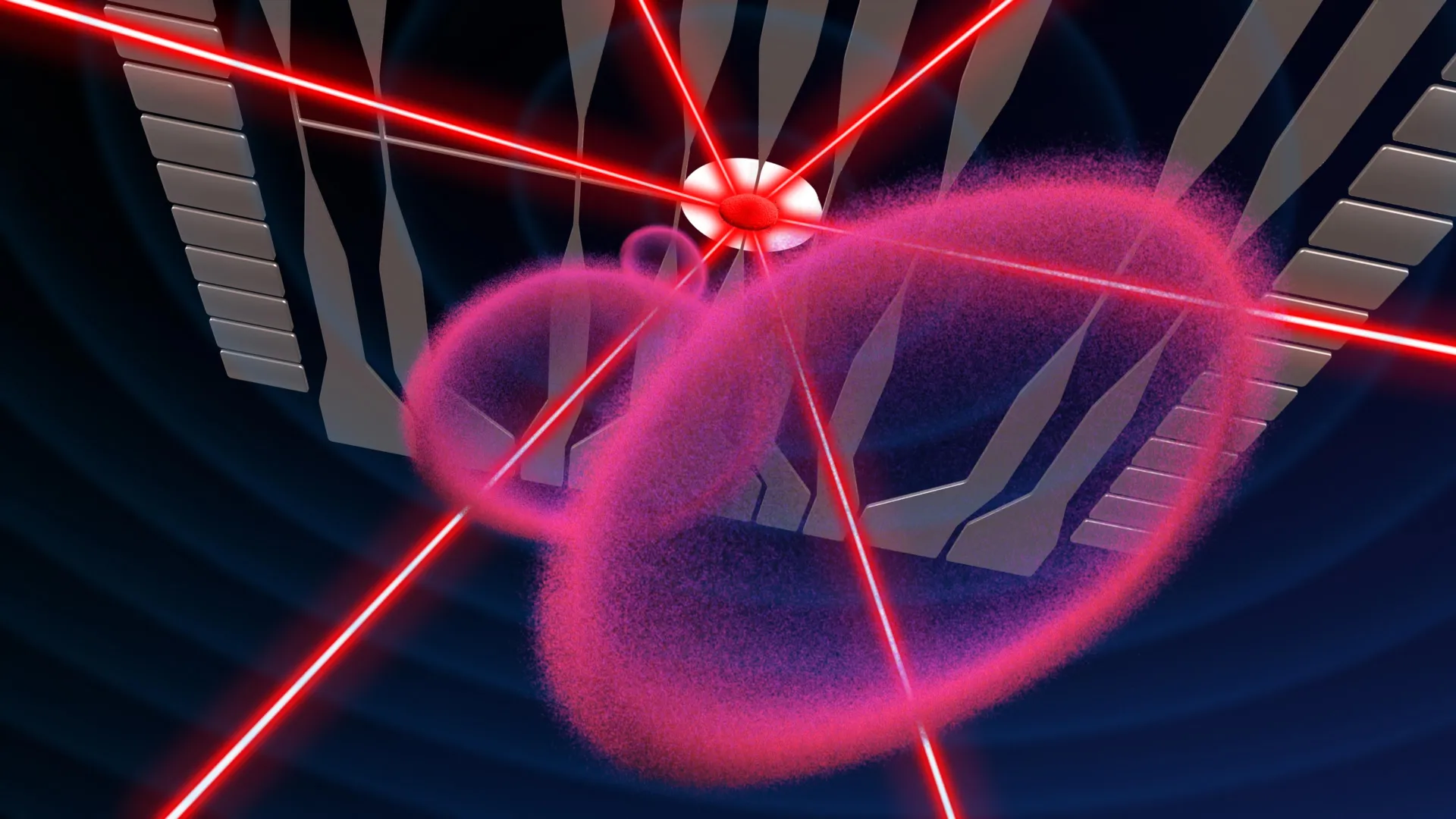
The process of making a BEC in orbit starts with heat, not cold. Strips of rubidium or potassium metal are heated to as high as 750 degrees Fahrenheit (400 degrees Celsius) inside a vacuum chamber, producing a gas. Then carefully tuned lasers are aimed at the atoms. The lasers remove energy from the atoms; as the atoms lose energy, they slow down and cool dramatically - a technique called laser cooling that works by exploiting the momentum of photons.
After that laser cooling stage, magnetic fields trap the atoms and hold them in place. Additional cooling techniques push their energy down even further, bringing the atomic cloud close to a complete standstill. The slower the atoms move, the colder they are, and the longer researchers can study the resulting quantum state before it degrades.
In microgravity, that study window stretches out. The matter waves grow larger. The measurements become more precise. The physics becomes stranger and more useful at the same time.
The Upgrade and What It Opens Up
The new science module that arrived on April 11 expands the range of experiments the lab can support. The original Cold Atom Lab was already the first facility to create Bose-Einstein condensates in orbit - a milestone in demonstrating that quantum technology can function reliably in the space environment. The upgraded module pushes the experimental toolkit further, giving researchers more control over the parameters of each run.
“The lab has lots of tools - especially with this latest upgrade - to let us probe the nature of the universe,” Williams said.
Ethan Elliott, deputy project scientist at JPL, has pointed to the orbital achievement as proof of concept for a broader ambition: quantum instruments that leave the laboratory and go to work in space. The ISS itself becomes, in this framing, less a destination than a proving ground - a place where the physics gets validated before the technology gets deployed somewhere harder to reach.
Measuring the Universe From Low Earth Orbit
What does it mean to measure time, gravity, and motion with quantum precision from a platform 250 miles above Earth? For navigation and geodesy, quantum sensors based on ultracold atoms could eventually outperform anything currently flying. For fundamental physics, the ability to isolate quantum systems from gravity’s interference - even partially - opens experimental regimes that have never been accessible.
The Cold Atom Lab is not running tourist experiments. The five teams currently using it are working on questions at the boundary of what is known about matter at the quantum scale.
At minus 459 degrees Fahrenheit, inside a box the size of a mini refrigerator, orbiting Earth every 90 minutes, those questions are getting answers that cannot come from anywhere else.